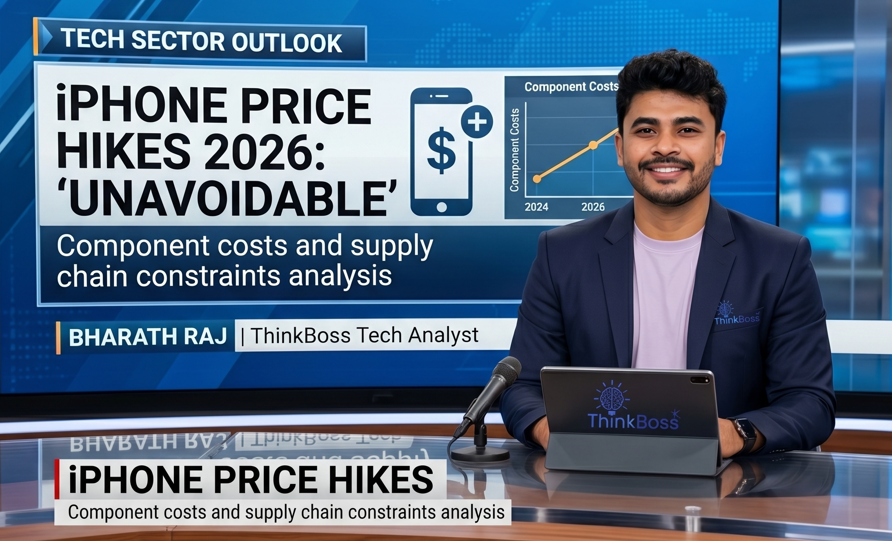
Nobody wants to hear this, but here it is: your next iPhone is going to cost more.
Tim Cook confirmed it himself not in a carefully worded press release, but in a direct interview with the Wall Street Journal. With the iPhone 18 launch just months away, Apple’s outgoing CEO made something clear that the company has avoided saying for years: the price increases are no longer something Apple can absorb on your behalf.
And the reason might surprise you. It’s not tariffs. It’s not inflation. It’s AI.
Table of Contents
- What Tim Cook Actually Said
- The Memory Chip Crisis Nobody’s Talking About
- How the AI Boom Is Hitting Your Wallet
- iPhone 18 Pricing: What to Expect
- What This Means for Buyers in India
- Buy Now or Wait? An Honest Answer
- Key Takeaways
- FAQs
What Tim Cook Actually Said {#what-tim-cook-said}
Cook didn’t dance around it. Speaking to the Wall Street Journal in what’s shaping up to be one of his final major media appearances before stepping down as CEO on September 1, 2026, he said:
“Unfortunately, price increases are unavoidable. We’re doing our best to mitigate the huge increases that are being passed to us, and we’ve been trying to shield our customers from the increases, but the situation has become unsustainable.”
For context — Apple has spent years quietly absorbing supply chain costs rather than passing them on to buyers. That strategy has always been part of how the brand justifies its premium positioning. So when Cook uses the word “unsustainable,” that’s not corporate spin. That’s a company telling you, as clearly as it can, that something has fundamentally changed.
What changed? The memory chip market.
“There’s less supply at a time when consumers want devices,” Cook told the Journal, “and the memory guys are passing along huge price increases. We definitely need memory pricing and supply to return to reasonable levels for consumer products. That’s the bottom line.”
The Memory Chip Crisis Nobody’s Talking About {#memory-chip-crisis}
Here’s what most headlines miss when they cover Apple’s price hikes: the real story isn’t Apple. It’s what’s happening inside the global semiconductor supply chain.
DRAM Dynamic Random-Access Memory is the working memory in every smartphone, laptop, and tablet. It’s what allows your phone to run multiple apps, process photos, and handle everything happening in the background. For decades, DRAM followed a simple rule: it kept getting cheaper as manufacturing scaled up. That rule no longer applies.
Shawn Kim, head of Morgan Stanley’s Europe and Asia technologies division, described the shift in stark terms. Memory prices have risen more than sixfold in a single year. He’s calling it “chipflation” and the numbers back it up. The global memory chip market is on track to hit $890 billion by the end of 2026. Just a year ago, it was worth around $220 billion.
That’s not gradual growth. That’s a supply shock.
Kim also warned that smartphone manufacturers could face a 12% shortfall in memory chips equivalent to roughly 134 million devices worth of supply. The ripple effects of that aren’t just theoretical. They’re showing up directly in what Apple is being charged for the components inside your iPhone.
How the AI Boom Is Hitting Your Wallet {#ai-boom-wallet}
Here’s the connection most people haven’t made yet: every time a tech company expands its AI infrastructure, it indirectly raises the cost of your next phone.
AI servers require a specialised type of memory called high-bandwidth memory, or HBM. It’s a layered, ultra-fast form of DRAM that handles the enormous data throughput AI models demand. The companies building AI data centres think the major cloud providers and AI labs — are ordering HBM at a scale the memory industry simply wasn’t designed to meet this quickly.
The result? Memory manufacturers are prioritising high-margin HBM orders over standard DRAM production. Less DRAM on the market means higher prices for everyone buying it including Apple.
“AI has turned memory from the cheapest part of the digital economy into one of its most contested resources,” Kim said. That’s the kind of structural shift that doesn’t reverse quickly, even if demand cools slightly.
What this means practically: the AI features being promoted on your current iPhone? They’re partly responsible for making the next one more expensive.
iPhone 18 Pricing: What to Expect {#iphone-18-pricing}
Cook declined to give specific numbers — but analysts and research firms are starting to fill in the blanks.
TechInsights estimates that the iPhone 18 Pro could come in at around $1,299, a jump of more than $200 over the iPhone 17 Pro’s $1,099 starting price. The Pro Max is expected to again cross $2,000 at higher storage tiers.
The September 2026 launch is also widely expected to include Apple’s first foldable iPhone alongside the standard iPhone 18 Pro and Pro Max. A foldable device requires significantly more complex display and memory components — so if you were hoping the foldable would be priced accessibly, temper those expectations.
| Model | iPhone 17 Price | Estimated iPhone 18 Price |
|---|---|---|
| iPhone 18 (base) | $799 | $899–$999 |
| iPhone 18 Pro | $1,099 | ~$1,299 |
| iPhone 18 Pro Max | $1,199+ | $1,399+ |
| iPhone 18 Fold | N/A | $2,000+ |
These are estimates — Apple hasn’t confirmed anything. But the direction is clear.
What This Means for Buyers in India {#india-buyers}
Indian pricing for iPhones has always carried a premium over the US price — import duties, GST, and currency conversion all add up. The iPhone 17 Pro launched at ₹1,19,900 in India. If the iPhone 18 Pro lands at ~$1,299 in the US, Indian buyers could realistically be looking at ₹1,30,000–₹1,40,000 for the base Pro model.
There’s a partial bright side. Apple has been scaling up manufacturing in India through Foxconn and Tata Electronics. If more India-sold iPhones are produced domestically, some of the duty-related premium could ease over time. But don’t expect that to fully cancel out the memory cost increases — the supply problem affects all markets equally.
[Link: ThinkBossMedia guide to buying iPhones in India at the best price]
Buy Now or Wait? An Honest Answer {#buy-now-wait}
If you’re sitting on an iPhone 13 or iPhone 14, the honest advice is to buy the iPhone 17 Pro now. It’s a genuinely excellent device, current pricing isn’t going to drop meaningfully before September, and the iPhone 18’s price jump will make today’s prices look reasonable in hindsight.
If you’re coming from an iPhone 15 or 16, the calculus is different. The generational upgrade isn’t significant enough to justify paying today’s Pro price when you could wait a few months, see what the iPhone 18 actually delivers, and make a fully informed decision.
And if the foldable iPhone is what you’ve been waiting for just be prepared. First-generation foldables from any manufacturer have historically launched at a steep premium. Apple’s first attempt is unlikely to be an exception.