For over a decade, Google sat at the top of digital advertising unchallenged, dominant, and seemingly permanent. That era just ended.
In 2026, Meta has overtaken Google in global digital ad revenue for the first time in history. This isn’t a minor reshuffle. It’s a signal that the rules of digital marketing have fundamentally changed and if your ad strategy still treats Google as the default, you’re already playing catch-up.
Table of Contents
- The Numbers That Changed Everything
- Why Meta Won This Race
- What This Means for Your Marketing Budget
- Is Google Down for the Count?
- The Authenticity Shift Running Parallel to This
- Key Takeaways
- FAQs
The Numbers That Changed Everything
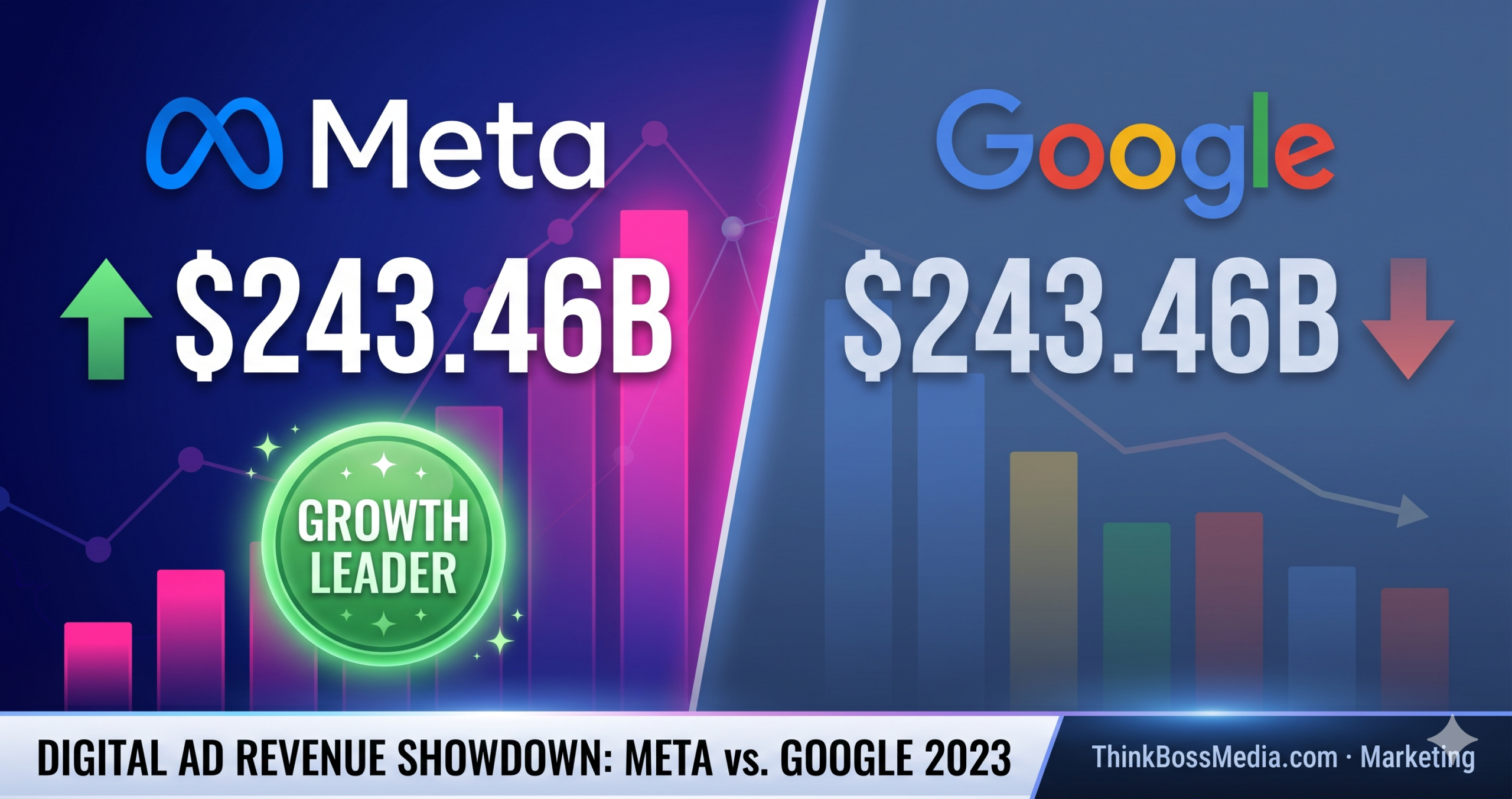
According to Emarketer’s 2026 forecast, Meta is projected to generate $243.46 billion in global net ad revenue this year, compared to Google’s $239.54 billion. That puts Meta at 26.8% of worldwide digital ad spend edging past Google’s 26.4%.
The gap looks small on paper. But it represents something much larger: Meta growing at 24.1% year-over-year in 2026, while Google grows at 11.9%. One platform is accelerating, the other is cruising. When those two trajectories run long enough, the crossover becomes inevitable — and it just happened.
Just a year earlier, in 2025, Google held a $17.89 billion lead. That lead didn’t shrink gradually. It collapsed fast.
Why Meta Won This Race
Here’s the thing most coverage won’t tell you: Meta didn’t win because of Instagram Reels alone. It won because it built an AI-powered advertising engine that now does the heavy lifting for brands of every size.
The centrepiece is Advantage+, Meta’s AI ad automation stack. Advantage+ campaigns are now generating approximately $60 billion in annualised revenue, reportedly delivering 22% higher returns than manually configured campaigns. For context over one million advertisers used Meta’s AI tools to create more than 15 million ads in a single month in 2025.
That’s not a feature. That’s an ecosystem.
At the same time, Meta has been quietly expanding its ad inventory across WhatsApp and Threads, two surfaces that barely registered on advertiser radars three years ago. Both are now genuine revenue contributors, and neither one cannibalises the others.
Short-form video through Reels is attracting real budget shifts from brands that once defaulted to YouTube. And the platform’s core strength — scale, network effects, and deep behavioural data — continues to compound in ways that are structurally hard for any competitor to replicate.
What This Means for Your Marketing Budget
If you’re managing ad spend right now, this milestone should prompt a genuine budget review — not a panic, but a deliberate reassessment.
Three immediate questions worth asking:
- Where is your performance actually coming from? Attribution is messier than ever, especially with AI search changing how buyers research before they click. Don’t assume Google is working just because it’s familiar.
- Are you using Meta’s AI tools or still running manual campaigns? If you haven’t explored Advantage+ shopping or campaign-level automation, you’re leaving efficiency — and ROAS — on the table.
- Are you present where attention actually lives? Reels, Instagram Stories, and even WhatsApp are reaching audiences who increasingly don’t use Google Search as their first stop for discovery.
This doesn’t mean abandoning Google. Search intent is still valuable, and Google’s dominance in that category remains intact. But the days of defaulting 70% of digital budget to Google without questioning it? Those should be over.
Is Google Down for the Count?
No — and that framing misses the point. Google’s ad business is still growing at 11.9%, still controls a massive share of search, and YouTube continues to outperform most video ad platforms for brand campaigns.
What’s changed is momentum. And in digital advertising, momentum is the thing that eventually determines market structure.
Google has its own AI advertising evolution underway. At Google Marketing Live 2026, the company formalised what it calls an agentic advertising model — essentially AI that builds, adjusts, and optimises campaigns with minimal human input. The May 2026 Core Algorithm Update also tightened the relationship between content structure and AI Overview citations, reshaping what “ranking” even means in a world where search results increasingly include AI-generated summaries.
The real story is that both platforms are racing to become AI-first advertising engines. The difference is that Meta built that capability into its performance stack first, and advertisers followed.
The Authenticity Shift Running Parallel to This
This ad revenue power shift doesn’t exist in isolation. Running alongside it is one of the strongest trend signals of 2026: consumers pushing back against AI-generated marketing content.
The backlash to Svedka’s AI-generated Super Bowl LX spot was a public wake-up call for brand marketers. Cannes Lions 2026, running June 22–26 in Cannes, has built its entire programme around human creative authority positioning the festival as a counter-signal to two years of AI-generated-everything.
The brands winning on Meta right now are the ones combining AI automation on the backend with genuine human voice on the front end. Founder-led content, unpolished behind-the-scenes storytelling, and community response these are the formats driving engagement on the very platforms where ad budgets are now concentrating.
The formula isn’t AI vs human. It’s AI for efficiency, humans for trust.
Key Takeaways
- Meta is projected to reach $243.46B in global ad revenue in 2026 overtaking Google’s $239.54B for the first time ever
- Meta’s growth rate (24.1%) is more than double Google’s (11.9%), making the momentum gap more significant than the revenue gap
- Meta’s Advantage+ AI automation is generating ~$60B in annualised revenue with a 22% higher ROAS than manual campaigns
- New ad surfaces on WhatsApp and Threads are opening incremental inventory beyond Facebook and Instagram
- Google remains strong in search intent but the default allocation of ad budgets to Google is now worth challenging
- Consumer backlash to AI-generated content is growing; brands that pair automation with authentic human voice are winning
- The best marketers in 2026 aren’t picking one platform they’re understanding where attention and intent converge
FAQs
Q: Has Meta actually overtaken Google in ad revenue right now? A: According to Emarketer’s forecast, yes 2026 is the year Meta is projected to surpass Google in global digital ad revenue for the first time. The numbers are close ($243.46B vs $239.54B), but the momentum clearly favours Meta.
Q: Should I move my ad budget from Google to Meta? A: Not necessarily and not without proper attribution analysis first. Google still dominates search-intent advertising. The smarter move is to audit where your actual ROAS is coming from, then allocate accordingly rather than following the headline.
Q: What is Meta Advantage+ and why does it matter? A: Advantage+ is Meta’s AI-powered ad automation system. It handles targeting, creative testing, and campaign optimisation with minimal manual input. It’s generating $60B+ in annualised revenue and reportedly delivering 22% better returns than manually managed campaigns making it one of the most significant tools available to performance marketers right now.
Q: Is AI-generated ad content a good idea in 2026? A: It depends how you use it. AI is proving highly effective on the backend — for campaign setup, creative testing, and bid optimisation. But AI-generated ad creative (video, copy, imagery) is facing growing consumer pushback. The winning approach is AI-assisted production with authentic, human-first messaging.
Q: What does this shift mean for small and mid-sized businesses? A: Good news, actually. Meta’s automation tools were specifically built to benefit smaller advertisers who don’t have large in-house media teams. The self-serve tools have lowered the skill barrier significantly, meaning SMBs can now compete more effectively on a platform that just became the world’s biggest digital ad business.
Final Thoughts
The Meta vs Google digital ad revenue story of 2026 isn’t just a leaderboard change. It’s a map of where consumer attention is going, where marketing automation is heading, and what kinds of brands are going to win in the next phase of digital.
Google isn’t finished — but its dominance is no longer a given. Meta’s momentum is real, its AI tools are working, and the platforms most brands underestimated two years ago are now the ones commanding the largest share of global ad spend.
If your marketing strategy in 2026 still looks like it did in 2023, this is your signal to rethink it.
For more marketing insights, brand strategy, and digital trends visit ThinkBossMedia.com