India just had its strongest year of economic growth since 2022 and the numbers tell a story that most people haven’t fully heard yet.
While the rest of the world has been grappling with inflation, trade wars, and sluggish recovery, India is quietly rewriting its own financial playbook. The economy grew by an impressive 7.6% in FY 2025–26, surpassing earlier government projections that placed growth between just 6.3% and 6.8%. That’s not a small overshoot it’s a sign that something structural is changing.
So what’s driving it, who’s benefiting, and what are the risks still lurking? Let’s break it all down.
Table of Content
- India’s GDP Growth: The Big Picture
- Inflation Under Control — Finally
- The Digital Economy Revolution
- Jobs, Skills & the Employment Shift
- Global Headwinds India Still Faces
- What This Means for Everyday Indians
- Key Takeaways
- FAQs
India’s GDP Growth: The Big Picture
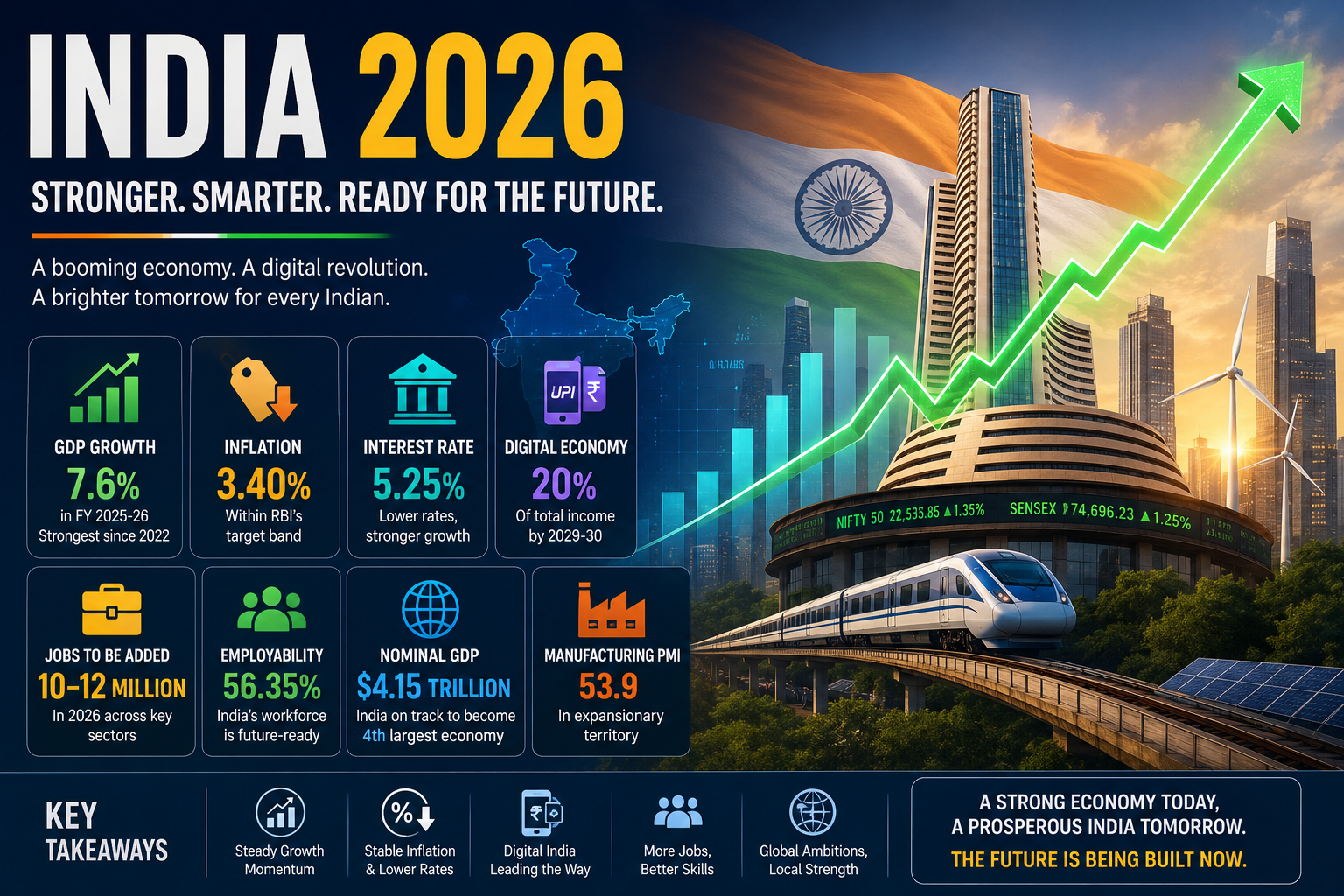
Let’s start with the headline: India’s real GDP grew at 7.6% in FY 2025–26, revised upward from an initial estimate of 7.4%. That makes it the fastest-growing major economy in the G20 and the numbers behind the growth are even more telling.
Private consumption (what regular households spend) accelerated to 7.7%, up significantly from 5.8% in the previous year. Government infrastructure spending also stayed elevated at 6.6%. In simple terms people are buying more, and the government is building more.
Looking ahead to FY 2026–27, projections vary. The RBI’s Annual Report forecasts 6.9% growth, while SBI Research places it slightly lower at 6.6%. Both figures, even at the conservative end, still make India one of the fastest-growing economies in the world.
What’s more, Goldman Sachs Research expects India’s nominal GDP to hit $4.15 trillion in 2026, edging the country closer to becoming the world’s fourth-largest economy a milestone that once seemed a decade away.
Inflation Under Control Finally
Here’s something that directly affects your grocery bill, your rent, and your savings.
India’s consumer price inflation (CPI) stood at just 3.40% in March 2026 comfortably within the RBI’s target band of 2–6%. That’s a dramatic improvement from the inflation spikes seen in 2022 and 2023.
Because of this breathing room, the Reserve Bank of India has been able to cut its policy interest rate to 5.25%, down 25 basis points. Lower interest rates mean cheaper home loans, cheaper business loans, and more liquidity flowing through the economy — all of which boost growth.
Rural inflation came in at 3.63%, while urban inflation was even lower at 3.11%, which signals that price pressures are easing across both cities and villages.
That said, economists aren’t popping champagne just yet. Crude oil price volatility, potential El Niño weather disruptions to food supply, and global commodity pressures could cause inflation to tick upward again in the second half of 2026.
The Digital Economy Revolution
This might be the most exciting and underreported chapter of India’s economic story.
India’s digital economy is currently growing at nearly twice the pace of the overall economy. And by 2029–30, it’s expected to contribute one-fifth of India’s total national income potentially surpassing both agriculture and manufacturing.
GST collections in March 2026 alone reached ₹1.78 lakh crore (~$20 billion), registering 8.2% year-on-year growth. This reflects improved compliance and steady economic activity powered heavily by digital transactions.
The manufacturing PMI held above the 50-mark (expansionary territory) at 53.9 in March 2026, supported by strong domestic demand and inventory building. The services sector, meanwhile, continues to be the largest contributor to GDP at 54.7%.
What does this mean practically? Digital infrastructure UPI, e-commerce, cloud services, and AI platforms is no longer just a tech story. It’s becoming the backbone of how India earns, spends, and grows.
Jobs, Skills & the Employment Shift
The employment picture in India is complex but the direction is encouraging.
India’s corporate sector could add between 10 to 12 million jobs in 2026, up from an estimated 8–10 million in 2025. Technology, BFSI (banking, financial services and insurance), manufacturing, renewable energy, and healthcare are leading hiring activity.
National employability has risen to 56.35% in 2026, up from 54.81% the previous year, according to the India Skills Report 2026. More striking: over 90% of Indian employees have already begun working with generative AI tools. India now commands 16% of the global AI talent pool.
The gig and freelance economy is also booming. It’s projected to reach 23.5 million workers by 2030, while project-based hiring has jumped 38% in the past year alone.
Here’s the honest reality though: India still needs to create 7.85 million non-agriculture jobs every year until 2030 just to keep pace with its growing workforce. The economy is creating jobs but the race between job creation and a young, rapidly expanding population is tight.
Global Headwinds India Still Faces
India’s growth story is real, but it’s not immune to outside forces. Three global risks stand out:
1. US Tariff Policy & Trade Deals The newly signed US-India trade deal is expected to reduce uncertainty and potentially unlock a private investment cycle. Earlier estimates put the drag from US tariffs at around 0.3–0.4% of GDP the new deal should help offset much of that. Still, the full impact on private capital expenditure may take time to materialise.
2. Geopolitical Tensions & Commodity Prices Ongoing conflicts in West Asia continue to pressure crude oil prices and disrupt key logistics routes, including the Red Sea corridor. Since India imports over 85% of its crude oil needs, any sustained spike in oil prices hits the economy hard — through higher fuel costs, higher import bills, and currency pressure on the rupee.
3. China’s Slow Recovery China’s sluggish economic rebound matters for India, both as a competitor in global supply chains and as a major source of raw materials. As India tries to position itself as an alternative manufacturing hub, Beijing’s dominance in critical minerals remains a strategic challenge.
On the domestic side, the rupee has faced depreciation pressure, and the government is working to address balance of payments concerns, particularly as crude prices rise.
What This Means for Everyday Indians
So how does all of this translate to real life?
If you’re a salaried professional, lower inflation means your purchasing power isn’t being eroded as badly as it was two years ago. Rate cuts make EMIs slightly cheaper — good news for anyone with a home loan or planning to take one.
If you’re an entrepreneur or small business owner, improved GST compliance infrastructure, digital payment ecosystems, and rising domestic consumption create genuine opportunities — especially in retail, logistics, and services.
If you’re a young graduate or job seeker, the emphasis on AI skills, digital fluency, and gig work means the job market rewards those who upskill actively. The India Skills Report data makes it clear: adaptability is the new job security.
And if you’re an investor, India’s macro fundamentals — controlled inflation, strong GDP growth, a growing middle class, and improving corporate earnings — continue to make a compelling case, even if short-term market volatility from global events remains a reality.
Key Takeaways
- India’s GDP grew at 7.6% in FY 2025–26, the highest since FY 2022
- CPI inflation is well-controlled at ~3.4%, giving the RBI room to cut rates
- The RBI cut its policy rate to 5.25% to support growth
- India’s digital economy is growing twice as fast as the broader economy
- 10–12 million new jobs are expected to be added in 2026
- India holds 16% of the global AI talent pool, with national employability rising
- Key risks include crude oil volatility, rupee depreciation, and global trade uncertainty
- India is on track to become the world’s fourth-largest economy
FAQs
Q: Is India really the fastest-growing major economy in the world? A: Yes. With 7.6% GDP growth in FY 2025–26, India leads the G20 in economic expansion, outpacing China, the US, and all major European economies.
Q: How does falling inflation help ordinary people? A: Lower inflation means your money buys more. It also gives the RBI space to cut interest rates, which lowers the cost of borrowing — making home loans, car loans, and business loans cheaper.
Q: What sectors are hiring the most in India in 2026? A: Technology, banking and financial services, manufacturing, renewable energy, and healthcare are the top hiring sectors. AI, data analytics, cloud computing, and cybersecurity are the most in-demand skills.
Q: What is the biggest economic risk for India right now? A: Crude oil prices and geopolitical tensions in West Asia pose the most immediate risk. Since India imports most of its oil, price spikes directly affect inflation, the trade deficit, and the rupee.
Q: When will India become the fourth-largest economy in the world? A: At current growth rates, India is on track to overtake Japan and Germany and secure the fourth spot in nominal GDP terms within the next few years — potentially as early as 2027–28 by some estimates.
Final Thoughts
India’s economic momentum in 2026 isn’t a fluke it’s the result of years of digital infrastructure investment, monetary discipline, and structural reforms finally bearing fruit. The fundamentals are strong. The opportunities are real. But so are the challenges, particularly around job quality, rural income, and global trade uncertainty.
The key for India and for every Indian navigating this economy is to stay informed, stay adaptable, and understand that growth at the macro level only becomes meaningful when it touches everyday lives.